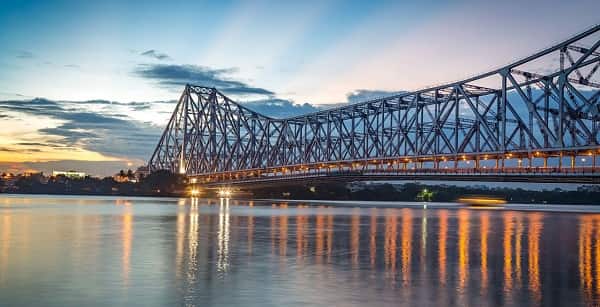
Howrah Bridge — officially and formally named Rabindra Setu since 1965, in honour of Nobel Laureate poet Rabindranath Tagore — is the most iconic, most photographed, most globally recognised, and most emotionally resonant landmark of Kolkata and indeed of all of West Bengal, spanning the sacred Hooghly River in an extraordinary cantilever arc of industrial-era engineering that has, since its inauguration on 3 February 1943, served as the primary crossing between the sprawling metropolis of Kolkata (formerly Calcutta) on the eastern bank and the industrially important city of Howrah on the western bank. The bridge was constructed by the Braithwaite, Burn and Jessop Construction Company to the design of M/s Rendell, Palmer and Tritton — a feat of engineering that required 26,500 tonnes of high-tensile steel, of which 87 per cent was supplied by Tata Steel. Construction began in 1936 and the bridge was opened to public traffic on 3 February 1943, replacing an earlier pontoon bridge that had served the crossing since 1874.
Howrah Bridge holds an extraordinary collection of engineering superlatives: it is 705 metres long, 21.6 metres wide with two pedestrian footpaths of 4.6 metres each on either side, 82 metres high at its twin pylons, and has a main span of 457.2 metres. It is a balanced cantilever bridge — and one of only four bridges of its type ever built in the world — constructed entirely without a single nut or bolt, with the entire steel structure held together exclusively by rivets, approximately 2,686,000 of them driven into 26,500 tonnes of steel. Most remarkably, the bridge stands on two pylons on either bank without a single pier in the river itself — deliberately engineered to avoid obstructing Hooghly River traffic, which was then among the world’s busiest commercial waterways. The bridge is officially designated the world’s busiest cantilever bridge — carrying an estimated 200,000 vehicles and 150,000 pedestrians daily. It has witnessed everything from World War II to Bengal’s Partition and the transformation of Calcutta into modern Kolkata, and remains not merely a physical structure but a living symbol of the city’s spirit and soul.
Howrah Bridge Location
Howrah Bridge spans the Hooghly River between Strand Road, Kolkata — on the eastern (Kolkata) bank — and the immediate vicinity of Howrah Junction Railway Station on the western (Howrah) bank, making it both a tourist landmark and the literal gateway to Kolkata.
- Address: Rabindra Setu (Howrah Bridge), 1 Strand Road, Jagannath Ghat, Kolkata, West Bengal — 700001 (Kolkata side) / Howrah, West Bengal — 711101 (Howrah side)
- Pin Code: 700001 (Kolkata) / 711101 (Howrah)
- STD Code: 033
- Administrative Zone: Ward 26 / Ward 27 — Kolkata Municipal Corporation / Kolkata Parliamentary Constituency
| Reference Point | Distance |
| Howrah Junction Railway Station | 1 kilometre — 5 to 10-minute walk (Howrah side) |
| Sealdah Railway Station (Kolkata) | 4 kilometres |
| Strand Road (Kolkata bank) | At the bridge |
| Jagannath Ghat | Adjacent |
| Mullick Ghat Flower Market | Adjacent — 200 metres |
| Princep Ghat | 3 kilometres |
| Esplanade (Kolkata city centre) | 3 kilometres |
| Mahatma Gandhi Road Metro Station | 2 kilometres |
| Howrah Metro Station (Green Line) | 1 kilometre (Howrah side) |
| Netaji Subhash Chandra Bose International Airport | 20 kilometres |
| Victoria Memorial | 5 kilometres |
| Dakshineswar Temple | 15 kilometres |
Directions to Howrah Bridge
Howrah Bridge is accessible from every direction of Kolkata and Howrah via road, metro, railway, bus, and ferry — its central location on the Hooghly River makes it one of the most multi-modally connected landmarks in India.
From Howrah Junction Railway Station
Walk eastward toward the river — approximately 1 kilometre — 5 to 10-minute walk. Howrah Junction is directly connected to the bridge approach on the western bank. Most visitors arriving by train to Howrah naturally walk to the bridge.
From Sealdah Railway Station (Kolkata)
Take Strand Road westward via cab or bus → approximately 4 kilometres — 15 to 25 minutes.
From Netaji Subhash Chandra Bose International Airport
Take cab via VIP Road → Ultadanga → Shyambazar → Strand Road → approximately 20 kilometres — 45 to 70 minutes depending on traffic.
From Esplanade / City Centre
Take a cab or bus westward via Strand Road → approximately 3 kilometres — 8 to 15 minutes.
By Ferry
Take one of the regularly operating river ferries between Kolkata and Howrah — the ferry ghat at Howrah and Bagbazar offer spectacular views of the bridge from the water, especially at dusk and dawn.
Road Connectivity Howrah Bridge
Howrah Bridge is the most critical road connection between Kolkata and Howrah — carrying six lanes of traffic with two dedicated pedestrian footpaths — and connecting Strand Road on the Kolkata bank to GT Road and NH-12 on the Howrah bank.
| Road | Direction | Connectivity |
| Strand Road (Kolkata) | East toward city centre | Esplanade, BBD Bagh (Dalhousie), Park Street, Victoria Memorial |
| GT Road (NH-12) — Howrah side | West toward Howrah | Howrah Junction, Shibpur, Uluberia, Durgapur, Delhi |
| AJC Bose Road | South | Park Street, South Kolkata |
| Rabindra Sarani | North | Shyambazar, Dum Dum, Airport direction |
| Brabbourne Road | South–East | Central Business District, GPO |
| Hooghly River Ferry Routes | Across the river | Bagbazar Ghat, Howrah Ghat — scenic alternative to road |
Metro and Transit Connectivity Howrah Bridge
Kolkata’s expanding Metro network provides good access to the Howrah Bridge zone — with two lines serving the immediate bridge vicinity from both the Kolkata and Howrah sides.
| Station | Line | Distance | Notes |
| Howrah Metro Station | Green Line (East–West Metro) | 1 km (Howrah side) — operational since March 2024 | East–West Metro — connects to Esplanade, Salt Lake |
| Mahatma Gandhi Road Metro Station | Blue Line (North–South) | 2 km (Kolkata side) | North–South Metro — connects to Dum Dum and Kavi Subhash |
First Metro (Green Line): 6:45 AM. Last Metro (Green Line): 9:45 PM.
Railway Connectivity Howrah Bridge
| Station | Distance | Line | Notes |
| Howrah Junction Railway Station | 1 km (Howrah side) | Eastern and South Eastern Railway | One of India’s busiest railway junctions — all major trains |
| Sealdah Railway Station | 4 km (Kolkata side) | Eastern Railway | Second major Kolkata junction — suburban and express trains |
Nearby Areas and Landmarks Howrah Bridge
| Landmark / Area | Distance | Description |
| Mullick Ghat Flower Market | 200 metres | One of Asia’s largest wholesale flower markets — operational from 3 AM daily |
| Howrah Junction | 1 km | One of India’s busiest and most iconic railway stations |
| Jagannath Ghat | Adjacent | Heritage Ganges-side bathing and worship ghat |
| Princep Ghat | 3 km | Beautifully restored Hooghly riverfront promenade — evening strolls, boat rides |
| Victoria Memorial | 5 km | Kolkata’s most iconic monument — colonial-era marble masterpiece |
| BBD Bagh (Dalhousie) | 3 km | Colonial-era business and government district |
| Park Street | 5 km | Kolkata’s most vibrant dining, entertainment, and cultural street |
| Dakshineswar Kali Temple | 15 km | One of Bengal’s most revered temples — associated with Ramakrishna Paramahamsa |
Frequently Asked Questions (FAQs)
Q1. Where is Howrah Bridge located in Kolkata?
A: Howrah Bridge (Rabindra Setu) spans the Hooghly River between 1 Strand Road, Jagannath Ghat, Kolkata — PIN 700001 — and Howrah Junction, Howrah — PIN 711101. It is approximately 1 kilometre from Howrah Junction Railway Station.
Q2. What is the official name of Howrah Bridge?
A: Howrah Bridge was officially renamed Rabindra Setu in 1965, in honour of Nobel Laureate poet Rabindranath Tagore. However, it remains universally known as Howrah Bridge.
Q3. How do I reach Howrah Bridge from Kolkata Airport?
A: Take a cab from Netaji Subhash Chandra Bose International Airport via VIP Road and Shyambazar toward Strand Road — approximately 20 kilometres and 45 to 70 minutes depending on traffic.
Q4. Which Metro station is nearest to Howrah Bridge?
A: Howrah Metro Station on the Green Line (East–West Metro) is approximately 1 kilometre from the bridge on the Howrah side. Mahatma Gandhi Road Metro Station (Blue Line) is approximately 2 kilometres on the Kolkata side.
Q5. Is there an entry fee to visit Howrah Bridge?
A: No. Howrah Bridge is open to all pedestrians and vehicles 24 hours, free of charge. Photography from the bridge and the ghats is unrestricted, though photography of security installations is prohibited.