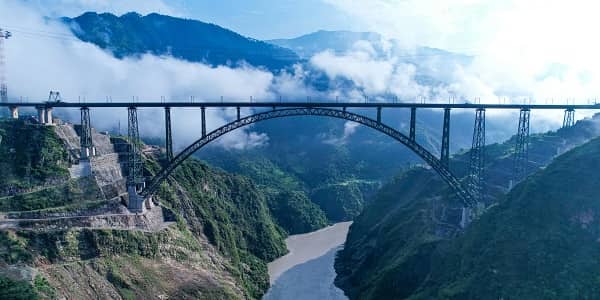
Chenab Bridge — the world’s highest railway bridge — is the most extraordinary engineering achievement in India’s modern infrastructure history and a landmark that has firmly placed India among the world’s elite nations in large-scale bridge construction, soaring 359 metres above the bed of the Chenab River in the Reasi district of Jammu and Kashmir — a height that surpasses the Eiffel Tower (324 metres) by 35 metres, surpasses the Qutub Minar stacked nearly seven times over, and exceeds most of the world’s tallest structures outside of purpose-built skyscrapers. The bridge was inaugurated for regular railway traffic on 6 June 2025 by Prime Minister Narendra Modi — one of India’s most celebrated infrastructure milestones of the decade — enabling the historic first-ever direct rail connection between Katra (in the Jammu region) and Srinagar (in the Kashmir Valley), transforming the connectivity of the Kashmir Valley to the national railway grid for the first time in modern history.
The Chenab Rail Bridge is a steel and concrete two-ribbed arch bridge spanning a total of 1,315 metres across the deep gorge of the Chenab River, with a main arch span of 467 metres — the longest rail bridge main span in the world. It comprises an approach bridge of 530 metres and a main deck arch bridge of 785 metres. The 17 spans are supported by steel piers, the tallest of which stands 133.7 metres high — alone taller than a 40-storey building. A colossal 26,500 tonnes of steel-equivalent material was employed in its construction, and the bridge is designed for a 120-year lifespan. The bridge was built by Chenab Bridge Project Undertaking — a joint venture of Afcons Infrastructure, VSL India, and South Korea’s Ultra Construction and Engineering — supervised by the Konkan Railway Corporation and designed with input from IITs, DRDO, and the Geological Survey of India.
The engineering challenges overcome at Chenab Bridge were unprecedented — the construction site sits in one of the world’s most geologically active and seismically sensitive mountain zones, subject to earthquakes, cyclonic winds at 266 km/h, temperatures of −20°C, and the additional security requirement of building blast-proof infrastructure in a sensitive border region. The bridge is constructed of 63mm-thick special blast-proof steel, designed to withstand earthquakes of magnitude 8 on the Richter scale and blasts equivalent to 40 tonnes of TNT. It forms part of the Jammu–Udhampur–Srinagar–Baramulla Rail Link (JUSBRL) — the ₹28,000-crore national project that connects Jammu to Baramulla across 345 kilometres of the most challenging Himalayan terrain ever crossed by a railway line.
Chenab Bridge Location
Chenab Bridge is positioned between the Bakkal and Kauri railway stations in the Reasi district of Jammu and Kashmir — on the Jammu–Baramulla Rail Line — in a deep river gorge formed by the Chenab River as it cuts through the lower Himalayan ranges approximately 600 kilometres north of New Delhi.
- Address: Chenab Rail Bridge, Between Bakkal and Kauri Railway Stations, Reasi District, Jammu and Kashmir — 182101
- Pin Code: 182101
- Administrative Zone: Reasi District — Union Territory of Jammu and Kashmir / Udhampur-Doda Parliamentary Constituency
| Reference Point | Distance |
| Bakkal Railway Station | 1 kilometre |
| Kauri Railway Station | 1 kilometre |
| Reasi Town | 35 kilometres |
| Katra (Mata Vaishno Devi base town) | 45 kilometres |
| Udhampur | 65 kilometres |
| Jammu Tawi Railway Station | 110 kilometres |
| Srinagar | 170 kilometres (via the new rail corridor) |
| Jammu Airport (Satwari) | 110 kilometres |
| Srinagar Airport | 180 kilometres |
| New Delhi | 600 kilometres |
Directions to Chenab Bridge (Viewing)
Chenab Bridge is not a tourist bridge in the conventional sense — it is an active railway structure traversed by trains on the Katra–Srinagar rail corridor. Visitors can view the bridge from nearby roadside viewing points on the Jammu–Reasi–Katra road corridor and experience its grandeur by taking the train that crosses it between Katra and Srinagar.
By Train (The Most Spectacular Way)
Take any train on the Katra–Srinagar rail corridor — the Vande Bharat Express or other services from Katra → the train crosses the Chenab Bridge as the most dramatic single moment of the journey — approximately 45 kilometres from Katra — before continuing onward to Banihal and Srinagar.
From Jammu Tawi Railway Station
Take the train toward Katra → continue onward to the Chenab Bridge crossing → approximately 110 kilometres — 2 to 2.5 hours by train.
From Katra (Mata Vaishno Devi)
Take the train from Katra Railway Station toward Srinagar on the new JUSBRL rail corridor → the Chenab Bridge crossing is approximately 45 kilometres from Katra — 40 to 50 minutes by train.
From Reasi Town (By Road — Viewing Point)
Take the Jammu–Reasi–Katra road (NH-144A) → approximately 35 kilometres — 1 to 1.5 hours — local viewpoints along the road allow glimpses of the bridge structure in the gorge.
From Jammu by Road
Take NH-44 toward Udhampur → connect to NH-244 toward Reasi → approximately 80 to 110 kilometres — 2.5 to 3.5 hours. The bridge viewing points near Salal village and Reasi district allow roadside views of the structure.
Rail Connectivity Chenab Bridge
| Route | Details |
| Katra–Srinagar Rail Corridor (JUSBRL) | The primary rail corridor crossing Chenab Bridge — inaugurated 6 June 2025 — connects Katra (Jammu region) to Srinagar (Kashmir Valley) for the first time |
| Vande Bharat Express — Katra to Srinagar | Premier high-speed service crossing Chenab Bridge — travel time approximately 3 hours from Katra to Srinagar |
| Jammu Tawi–Katra–Srinagar services | Multiple daily services on the full JUSBRL corridor — Jammu to Srinagar via Chenab Bridge |
| Bakkal Station | Nearest station to the bridge — west/Jammu side |
| Kauri Station | Nearest station to the bridge — east/Kashmir side |
Road Connectivity Chenab Bridge
| Route | Details |
| NH-44 (Jammu–Srinagar National Highway) | Primary highway approaching the Reasi zone — available for road travellers |
| NH-144A (Katra–Reasi Road) | Most direct road to the bridge viewing zone — 35 km from Reasi to the bridge area |
| Jammu–Udhampur–Reasi Road | Alternate approach — via Udhampur to Reasi — 65 km from Udhampur |
| Private Taxi from Jammu | Available — Jammu Tawi to bridge viewing area approximately ₹2,000 to ₹3,000 per cab |
| Private Taxi from Katra | Available — the most popular base for Chenab Bridge day visits by road |
Nearby Areas and Landmarks Chenab Bridge
| Landmark / Area | Distance | Description |
| Mata Vaishno Devi Shrine, Katra | 45 km | India’s most visited pilgrimage shrine — 8 million devotees annually |
| Reasi Town | 35 km | District headquarters — Sufi shrines, Batote apple orchards, scenic Chenab valley |
| Jammu Tawi | 110 km | Jammu city — Raghunath Temple, Bahu Fort, Amar Mahal Palace Museum |
| Salal Dam | 20 km | Hydro dam on the Chenab River — scenic Himalayan backdrop |
| Srinagar | 170 km (via rail) | Kashmir Valley capital — Dal Lake, Mughal Gardens, Shankaracharya Hill |
| Patnitop Hill Station | 70 km | Popular hill station with cable car — scenic Himalayan views |
| Sanasar | 60 km | High-altitude meadow — paragliding and camping destination |
Frequently Asked Questions (FAQs)
Q1. Where is Chenab Bridge located?
A: Chenab Bridge is between Bakkal and Kauri railway stations, Reasi District, Jammu and Kashmir — PIN 182101 — approximately 45 kilometres from Katra and 110 kilometres from Jammu Tawi Railway Station. It is the world’s highest railway bridge at 359 metres above the Chenab riverbed.
Q2. Is Chenab Bridge open for regular train traffic?
A: Yes. Chenab Bridge was inaugurated for regular railway traffic by Prime Minister Narendra Modi on 6 June 2025 — connecting Katra (Jammu region) to Srinagar (Kashmir Valley) for the first time via the Vande Bharat Express and other scheduled train services.
Q3. How can I cross Chenab Bridge?
A: The most spectacular way is by taking the Vande Bharat Express or any scheduled train on the Katra–Srinagar corridor — the train crosses the 359-metre-high bridge as the single most dramatic moment of the journey. Viewing points on the Reasi–Katra road also allow roadside views.
Q4. How tall is Chenab Bridge compared to the Eiffel Tower?
A: Chenab Bridge’s deck stands 359 metres above the Chenab riverbed — 35 metres taller than the Eiffel Tower (324 metres) — making it not only the world’s highest railway bridge but taller than most of the world’s iconic structures.
Q5. Which airport is nearest to Chenab Bridge?
A: Jammu Airport (Satwari) is approximately 110 kilometres away. Srinagar International Airport is approximately 180 kilometres away via the new Katra–Srinagar rail corridor.